Responding to public and private tenders is a demanding sales channel. Each consultation represents dozens of hours of work (market watch, reading voluminous files, qualification, writing) for a success rate that, by nature, can never be guaranteed. This asymmetry between effort invested and outcome leads many companies to under-exploit this channel, or to respond to it in a rush, at the expense of quality.
We made a different choice: to build internal tools based on agentic AI to handle this channel end-to-end. Here is what these tools change in practice, and what it says about the business use cases we can build with AI today.
The problem: a slow, fragmented and costly process before you’ve even decided
Before writing a single line of a response, you have to clear several steps that, done manually, consume considerable time.
Market watch first: opportunities are scattered across several channels (BOAMP, JOUE, buyer platforms…), each with its own formats and volumes. Identifying the consultations relevant to your sector means a daily check and a tedious sort where most of the flow is noise.
Qualification next: a tender file (DCE) easily runs to several hundred pages spread across the technical specifications, the administrative clauses, the consultation rules and annexes. Extracting the technical requirements, the evaluation criteria and their weighting, the administrative constraints, the risky clauses and the schedule takes several hours of expert reading — only to conclude, in many cases, that you should not respond.
The decision, finally: the go/no-go often comes late, based on a partial reading, when every day counts against tight submission deadlines.
First tool: detect and decide fast
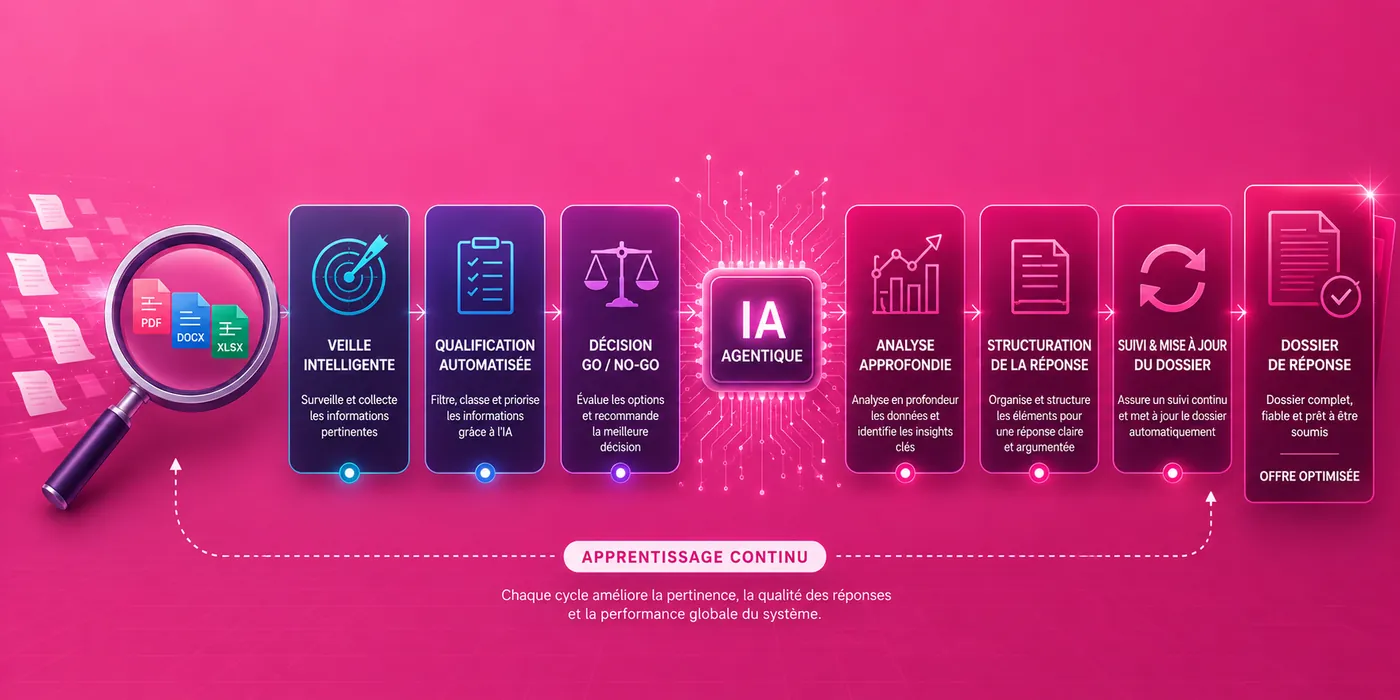
Our first tool covers the upstream part of the process. It continuously aggregates announcements from the various channels and applies our business filters: sector, keywords, CPV codes, geographic areas, amounts. The raw flow of hundreds of monthly announcements is thus automatically reduced to only the opportunities aligned with our positioning.
For the selected consultations, AI takes over the analysis of the file. The DCE is read and analyzed along several complementary axes: technical requirements, evaluation criteria and their weighting, administrative framework, financial dimension, contractual risks, and fit with our skills, references and capacities. Each axis produces a structured, sourced summary.
Everything converges toward a reasoned go/no-go recommendation: decisive factors, strengths and weaknesses of our positioning, effort estimate, deadline criticality. The decision stays human — that’s a principle for us — but it is now made with full knowledge of the file, in a fraction of the time.
One last key element: a chat lets you query the file’s content directly in natural language. Rather than manually hunting for a clause across hundreds of pages, you ask the question and get the answer with the source passages cited. The tool also learns from our corrections and past decisions to refine its analyses over time.
Second tool: going from “go” to the response file
Once the decision to respond is made, a second tool orchestrates specialized AI agents, each responsible for one part of the work.
Some agents deepen the analysis: an exhaustive mapping of requirements by domain (functional, technical, operational, contractual), identifying points of attention and the levers to maximize the score. Others structure the response: building the complete list of expected deliverables per envelope, with their mandatory or optional status. A domain where the smallest omission can invalidate weeks of work.
The tool lets you follow the consultation throughout its entire lifecycle, from publication to bid submission. For example, when items are added to or modified in the file, it identifies the impacts of the change (deadlines, requirements, scope…) and, after the team’s validation, updates its analysis accordingly. We then work in collaboration with the AI on assembling the response file and optimizing our offer. But that — that stays our secret ingredient!
What it changes
The most visible gain is time. A DCE typically comprises 20 to 30 documents, i.e. several hundred pages. Its full analysis used to take an experienced profile a full day; it is now available in about thirty minutes. And where the go/no-go decision took roughly a week, it is now made the very day of detection.
But the qualitative gains count at least as much. Exhaustiveness, first: the agents read the entire file, systematically, where human reading under time pressure cuts corners. Traceability, next: every statement is sourced back to its origin document and page, which makes the analyses verifiable and auditable. Capacity, finally: at constant effort, we can process more opportunities, so we can be more selective about the ones we commit to — and more invested in those.
What changed in the way we work
The teams’ role has shifted: less information extraction, more strategy, judgment and relationship.
Some tasks have disappeared: the daily check of publication platforms, the manual search for a clause across hundreds of pages of PDF, re-entering requirements into spreadsheets, the full re-read of every file “just in case”.
New tasks of a different kind have appeared: reviewing and correcting the analyses produced by the AI (each correction feeds its learning, incidentally), validating impact reports when an addendum is published, maintaining the company profile and the watch filters that condition the quality of the recommendations.
Decisions are made earlier: the go/no-go of course, but also the effort estimate, the identification of partners to bring in and the broad orientations of the response — now discussed from day one on the basis of a complete analysis rather than at the end of the process.
And some trade-offs remain exclusively human: the final decision to respond, the pricing strategy, the contractual commitments we agree to make, the differentiating positioning of the offer. AI informs these choices; it does not make them.
What this experience teaches us
Tenders served as our experimentation ground, but the lesson goes far beyond this use case. Many enterprise processes still rest on reading, interpreting and coordinating large volumes of documents. Whenever these activities can be broken down into explicit steps, entrusted to specialized agents and validated by a domain expert, they become good candidates for an agentic approach. It is not the sector that determines the relevance of AI, but the nature of the process.
If these topics resonate with your own processes, let’s talk.
Our teams frame your roadmap and secure every step. Let’s talk.
Discuss your project →